Reformer Pilates vs Mat Pilates: 7 Key Differences and Which One Is Right for You
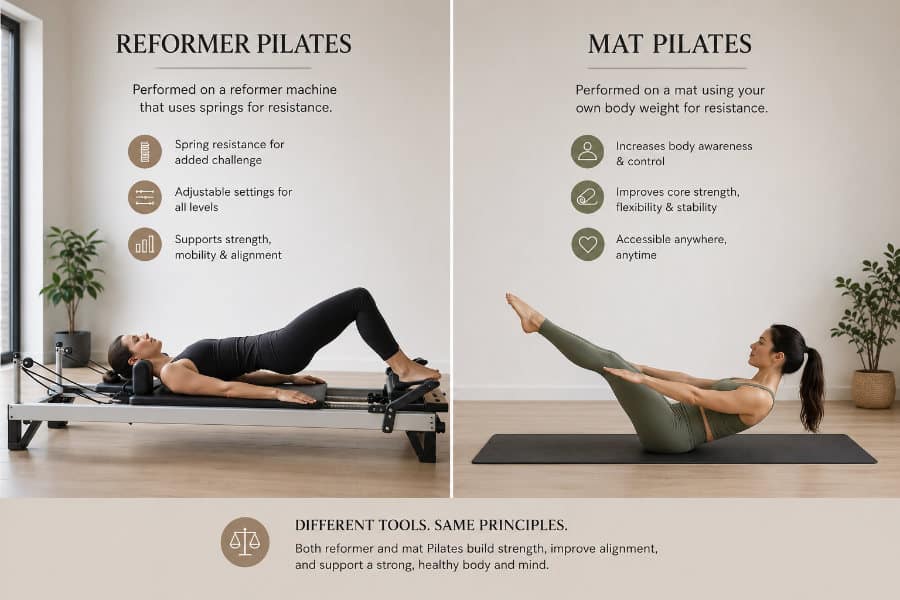
Reformer Pilates uses a spring-resistance machine to work your entire body through a wider range of exercises than mat work allows. Mat Pilates uses only your body weight and a mat, making it more accessible but more limited in what it can target. Both methods share the same Pilates principles, but they suit different goals, budgets, and experience levels. Here is exactly how they compare, and how to decide which one to start with.
In this article
- 1. The equipment
- 2. The resistance
- 3. The exercise range
- 4. Joint support and rehabilitation
- 5. Strength and body composition results
- 6. Cost and accessibility
- 7. Who each method suits best
- Side-by-side comparison table
- Which should you choose?
- Frequently asked questions
1. The equipment: machine vs mat
The most obvious difference is what you actually use. Mat Pilates requires nothing but a mat and your own body. You can do it in a living room, a hotel room, or a park. Reformer Pilates uses a carriage that slides along a frame, attached to a set of adjustable springs that provide resistance. The reformer also includes a footbar, shoulder rests, and various attachments that allow for dozens of exercise variations impossible on the mat alone.
Because the reformer machine provides a moving, supported surface, it changes the challenge of every exercise. Movements that feel straightforward on the mat become significantly more demanding when your base of support is sliding beneath you.
2. The resistance: body weight vs spring tension
Mat Pilates is a body-weight practice. The resistance in every exercise comes entirely from your own mass, working against gravity. This makes it excellent for building foundational core awareness and control, but it also means you cannot easily increase or decrease the challenge once your body adapts.
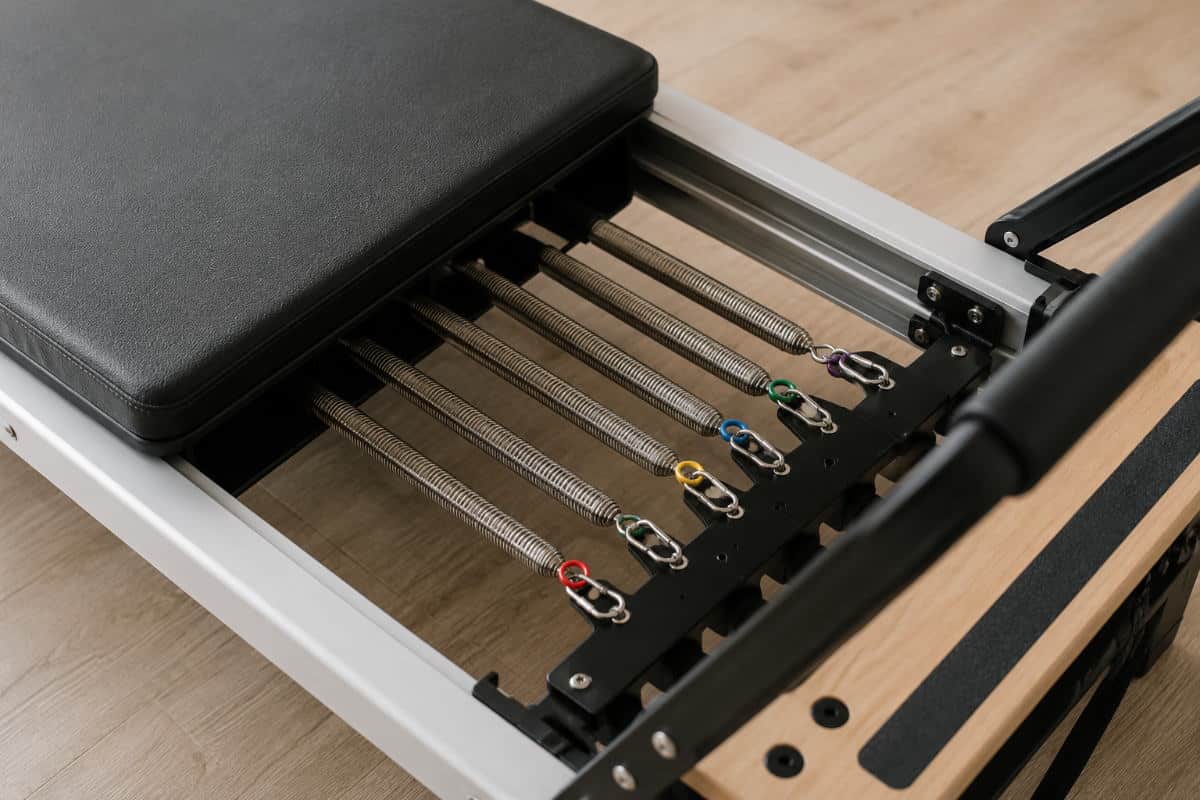
Reformer Pilates uses spring tension, which you can dial up or down instantly by changing which springs are attached. This means the machine can both assist you (using lighter springs to support you through a movement you cannot yet do under full load) and challenge you (by adding resistance as you grow stronger). It also means the reformer is just as effective for rehabilitation as it is for athletes.
3. The exercise range: limited vs extensive
Mat Pilates has a defined repertoire of around 30 to 40 core exercises, with variations. It focuses heavily on the trunk: the abdominals, lower back, glutes, and hip flexors. Most exercises are performed lying down, seated, or on all fours.
Reformer Pilates has a repertoire of over 200 exercises. The sliding carriage, spring system, and various attachments allow you to work in standing, kneeling, lying, seated, and even inverted positions. You can target the legs, glutes, back, shoulders, arms, and core within a single session, often in ways that challenge coordination and balance simultaneously.
4. Joint support and rehabilitation
Mat Pilates can be gentle and is often recommended for rehabilitation, but it requires you to manage your own bodyweight throughout, which is not always possible after injury or surgery.
The reformer excels here. By reducing spring resistance and lying on a supported, moving surface, you can perform exercises that decompress the spine, strengthen muscles around an injured joint, and restore range of motion with very little impact. Many physiotherapists use clinical reformers for post-operative rehabilitation, back pain, and hip or knee recovery precisely because the machine removes load from the body rather than adding to it.
5. Strength and body composition results
Both methods build strength, but they do so differently and at different speeds. Mat Pilates builds core endurance and body awareness steadily over time. It is a reliable foundation, but because the resistance never exceeds your body weight, your muscles can plateau if you do not add variety.
Reformer Pilates builds strength more quickly across a broader range of muscle groups because the spring resistance can be increased progressively. A 2025 study comparing the two methods found that reformer Pilates produced significantly better improvements in physical performance, including flexibility, power output, and sprint speed, compared to mat work over the same training period.
For visible toning of the legs, glutes, and arms in particular, the reformer has a clear advantage because it allows resistance to be applied through the full range of motion in these muscle groups, something mat Pilates cannot replicate.
6. Cost and accessibility
Mat Pilates is the more accessible starting point. A quality mat costs £20 to £60, and there is a huge range of free and low-cost online classes available. Studio mat classes in the UK typically cost £10 to £20 per session.
Reformer Pilates studio classes cost around £25 to £35 per session in the UK, reflecting the overhead of the machines and the smaller class sizes required. For regular practitioners, this adds up quickly: four sessions a month at £30 each is £360 a year.
Buying a home reformer changes that calculation significantly. Entry-level machines start from around £525 and provide unlimited sessions once purchased. Many people find a home reformer pays for itself within a year compared to studio fees, with the added benefit of being able to train whenever suits them.
7. Who each method suits best
Mat Pilates suits you best if you are brand new to Pilates and want to learn the foundational principles before adding equipment, if you have a very limited budget, if you travel frequently, or if you simply prefer bodyweight training with no machinery involved.
Reformer Pilates suits you best if you want faster, more visible results across your whole body; if you are recovering from an injury or managing back pain; if you want a more varied and progressive training method; or if you are at a stage where mat work is no longer challenging enough. It is also a better fit if you are working with a specific performance goal, such as improving posture, building core strength for another sport, or restoring strength after pregnancy.
Side-by-side comparison
| Mat Pilates | Reformer Pilates | |
|---|---|---|
| Equipment needed | Mat only | Reformer machine |
| Resistance type | Body weight only | Adjustable spring tension |
| Exercise variety | ~30 to 40 exercises | 200+ exercises |
| Joint support | Moderate | High (excellent for rehab) |
| Full-body strength | Core-focused | Whole body, including arms, legs and glutes |
| Suitable for beginners | Yes | Yes (machines assist early on) |
| Studio class cost (UK) | ~£10 to £20 per session | ~£25 to £35 per session |
| At-home option | Yes, from ~£20 (mat) | Yes, from ~£525 (machine) |
| Best for | Foundations, accessibility, travel | Results, progression, rehab, home studios |
Which should you choose?
If you have never done Pilates before, a few mat sessions or beginner-level online classes are a useful way to learn the core principles, the breathing patterns, and the basic exercise names before you step onto a reformer. That said, you do not need to "graduate" from mat work before trying the reformer. Reformer Pilates is completely appropriate for beginners, and many people find the machine makes learning easier because it guides your movement.
If you have done mat Pilates for a while and feel like you have hit a ceiling, the reformer is the obvious next step. The spring resistance, the wider exercise range, and the full-body engagement will challenge you in ways mat work simply cannot.
If back pain, a joint injury, or post-natal recovery is your reason for starting, go straight to the reformer. The ability to offload the spine and joints while still building strength is its biggest clinical advantage.
And if you are ready to bring your practice home, a reformer machine removes the ongoing cost of studio classes and lets you build a consistent daily habit on your own terms.
Frequently asked questions
Is reformer Pilates better than mat Pilates?
For most fitness goals, yes. Reformer Pilates works more muscle groups, allows progressive resistance, and produces faster visible results than mat Pilates. That said, mat Pilates is a genuinely valuable practice, particularly for building foundational core awareness and for anyone who wants a low-cost, no-equipment option. Many experienced practitioners do both.
Can a complete beginner do reformer Pilates?
Yes. The reformer machine can assist your movement by reducing load through lighter spring settings, which actually makes some exercises easier to learn than their mat equivalents. Most studios offer beginner reformer classes specifically designed for first-timers. If you are buying a machine for home use, starting with a few guided sessions at a studio first is worthwhile so you understand how to set it up correctly.
Is reformer Pilates good for back pain?
Reformer Pilates is widely used for back pain rehabilitation. The spring resistance system allows exercises that strengthen the muscles supporting the spine without loading or compressing it, and many exercises are performed lying down, which reduces spinal load further. It is recommended to tell your instructor about your back condition before your first session so they can adapt the programme for you.
How often should you do reformer Pilates to see results?
Most people notice improvements in posture, core strength, and flexibility within 4 to 6 weeks of practising 2 to 3 times per week. Visible body composition changes, such as toning in the legs, glutes, and abdominals, typically become more apparent after 8 to 12 weeks of consistent training. Having a machine at home makes this frequency much easier to maintain.
Can you do reformer Pilates at home without an instructor?
Yes, many people do. It is a good idea to take at least a few instructor-led sessions first so you understand how to set the machine up, how to adjust the springs, and how to perform the foundational exercises safely. Once you have that foundation, home training using online classes or video guidance is a practical and cost-effective way to build a consistent practice.
What is the difference between a foldable and a fixed pilates reformer?
A foldable reformer can be folded vertically for storage and is ideal for home use where space is limited. A fixed reformer stays in position and is more common in commercial studios. For home use, a foldable model is usually the better choice unless you have a dedicated exercise room. Both types use the same spring-resistance system and offer a full reformer workout.
