
Table of Contents
What Is Reformer Pilates? (Beginner’s Guide)
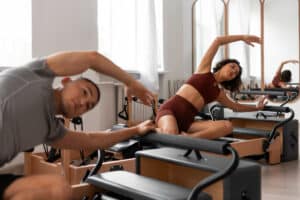
Reformer Pilates is a full-body, low-impact workout performed on a spring-based carriage machine called a Reformer.
Created by Joseph Pilates in the early 20th century, the method began as a rehabilitation system and was refined over decades of work with dancers, athletes, and people recovering from injury.
Today, Reformer Pilates is loved worldwide — especially across the UK — for improving posture, flexibility, and core strength. It’s suitable for all levels, from complete beginners to professional athletes and those recovering from injury.
If you’ve ever wondered what exactly Reformer Pilates is, how it differs from mat Pilates, or what to expect in a class, this guide will walk you through everything.
How Reformer Pilates Works
At first glance, the Reformer machine looks a little like a narrow bed with a sliding carriage, adjustable springs, footbar, and straps. Don’t be intimidated — it’s ingeniously designed to provide controlled resistance and support so you can strengthen and lengthen muscles at the same time.
The Reformer Machine Explained
- Carriage: the platform that glides back and forth on wheels.
- Springs: attach to the carriage and determine resistance level (light to heavy).
- Footbar & shoulder blocks: keep you stable and guide alignment.
- Straps & ropes: used for hands or feet to push and pull through movements.
As you move, these elements work together to engage multiple muscle groups — often the core, glutes, and back — improving control and precision without high impact on joints.
Benefits of Reformer Pilates
Practising Reformer Pilates regularly delivers both physical and mental rewards.
Physical Benefits
- Improves posture & alignment by strengthening deep stabilising muscles.
- Builds core strength and tones the entire body.
- Increases flexibility & joint mobility, helping counteract stiffness from sitting or desk work.
- Enhances balance & coordination through controlled, symmetrical movements.
- Supports rehabilitation after injury by allowing low-impact strengthening.
Mental & Lifestyle Benefits
- Encourages mind–body awareness and concentration.
- Promotes stress relief through breathwork and rhythmic motion.
- Boosts energy levels and posture confidence in daily life.
Many UK physiotherapists now recommend Reformer Pilates as part of rehabilitation programmes for back pain, shoulder instability, or post-surgery recovery because it strengthens the body in a safe, controlled way.
Reformer Pilates vs. Mat Pilates
Both Reformer and mat Pilates follow the same core principles — concentration, control, centring, precision, breath, and flow — but they differ in focus and equipment:
| Feature | Reformer Pilates | Mat Pilates |
|---|---|---|
| Equipment | Reformer machine with springs | Mat only |
| Resistance | Adjustable (springs & straps) | Bodyweight |
| Focus | Strength, alignment, mobility | Core stability & control |
| Best for | All levels, including rehab | All levels |
Many people find that combining both styles creates the most balanced Pilates practice.
Who Can Do Reformer Pilates?
Reformer Pilates can be adapted for any fitness level or goal.
Beginners can start with lighter springs to learn alignment.
Athletes can challenge themselves with higher resistance and complex sequences.
Rehabilitation clients can use the support of the carriage for gentle, precise movement.
Always let your instructor know about injuries or health concerns before class so they can adjust spring tension or exercises appropriately.
Medical and Physiotherapy Use
Because of its controlled nature, many physiotherapists incorporate Reformer Pilates into recovery programmes for knee, hip, or back issues. It’s also an excellent cross-training option for runners, cyclists, and dancers.
What to Expect in a Reformer Pilates Class
A typical class lasts 45–60 minutes and usually follows this structure:
Warm-up & breathing — engage core and connect to movement.
Lower-body strength — leg presses and footwork using springs.
Upper-body & arms — pulling straps or biceps work.
Core series — abdominal work for strength and stability.
Stretch & mobility — gentle, controlled cool-down.
Expect to feel muscles you didn’t know existed — but without pain or strain. You’ll finish feeling taller, stronger, and more balanced.
What to Wear and Bring
Fitted clothing that allows movement.
Grip socks for safety and hygiene.
Small towel and water bottle.
Avoid zips or jewellery that could catch on the machine.
How Often Should You Do Reformer Pilates?
For best results:
Beginners: 1–2 sessions per week to learn form.
Intermediate/Advanced: 3–4 sessions weekly to build strength and mobility.
Consistency is key — even one class per week can improve posture and core engagement within a month.
Find a Reformer Pilates Studio Near You
Ready to experience Reformer Pilates? Explore our Reformer Pilates studio directory to find trusted studios near you. You can filter by location, instructor, and class type to discover the best Reformer Pilates studios across the UK — from London to Manchester, Bristol and beyond.
Related Pages on ReformerPilatesClasses.co.uk
FAQs relating to reformer pilates benefits
What is Reformer Pilates?
Reformer Pilates is a dynamic, full-body workout performed on a spring-based machine called the Reformer. It improves posture, flexibility, and balance while building core strength and body awareness.
How is Reformer Pilates different from mat Pilates?
While mat Pilates relies mainly on bodyweight exercises, Reformer Pilates uses adjustable resistance springs, pulleys, and a sliding carriage. This allows for greater precision, support, and progression — ideal for both beginners and athletes.
Is Reformer Pilates good for beginners?
Yes — it’s perfect for all fitness levels. Instructors can modify the resistance and movements to match your ability. Beginners often find Reformer Pilates more supportive than mat work, thanks to the machine’s guided movement.
What are the benefits of Reformer Pilates?
Regular practice helps strengthen your core, improve flexibility, and enhance body alignment. It can also relieve back pain, increase mobility, and support injury recovery while promoting lean muscle tone.
How often should I do Reformer Pilates?
For visible results and better posture, aim for 2–3 sessions per week. Consistency helps build long-term strength, balance, and endurance.
Where can I find Reformer Pilates classes near me?
Use our UK-wide studio directory to find Reformer Pilates classes near you. Browse by location, class type, or instructor to find your ideal studio.
Can men do reformer pilates?
Absolutely. While studios skew female in client base, reformer is biomechanically agnostic and many male athletes — runners, cyclists, footballers, and rugby players — use reformer for hip mobility, core stability, and post-injury work. Some UK studios run mixed and male-only classes.
